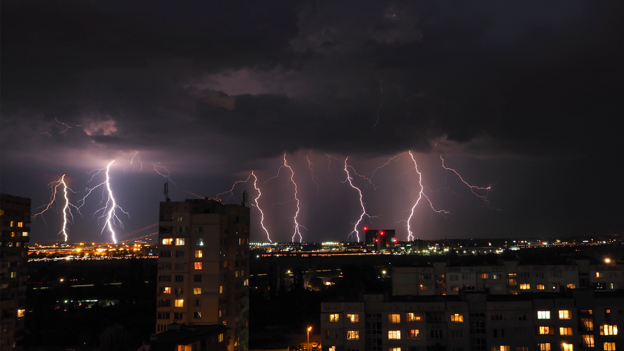
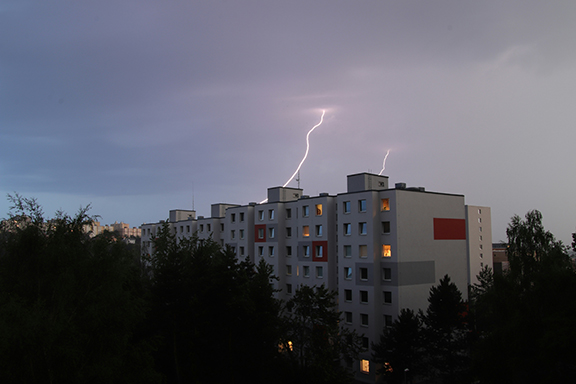
The sky darkens. Thunder rolls in from the west. Your crew looks up from the rooftop, waiting for someone to make the call. The storm is close, but no protocol tells you when to stop work. You’re deciding on instinct, not paperwork. If someone gets hurt, OSHA won’t accept “it didn’t look that bad” as a defense.
Lightning risk management is an employer-level framework for evaluating storm threats and making documented go/no-go decisions. Your protocols must satisfy OSHA compliance before your crew is exposed.
Defensible protocols combine probability thresholds with documented consequence analysis before storms arrive. This article provides a structured framework you can use and compliance teams can defend.
Main Takeaways:
- The 30-30 rule for lightning suspends work when lightning is within six miles and resumes 30 minutes after the last flash or thunder.
- OSHA enforces lightning safety under the General Duty Clause. This requires written plans, trained crews, and documented suspension decisions.
- Ground current injures more people than direct strikes, which is why spreading crews 50–100 feet apart reduces risk.
- Lightning strike victims carry no electrical charge and can be touched immediately to begin CPR if needed.
Justify Lightning Safety Spend with Data
See how industrial teams quantify lightning exposure, downtime, and compliance costs, so you can defend prevention budgets before the next storm season.
How to Assess Lightning Risk Before Outdoor Work Begins

Lightning risk management follows a four-step decision process:
- Evaluate the threat.
- Estimate probability.
- Weigh consequences.
- Set go/no-go thresholds.
All four steps happen before your crew is exposed, not while they’re on a roof watching the sky darken.
Lightning risk management is how an employer assesses storm threat and documents suspension decisions. A lightning safety plan tells one person to head indoors. Your job is deciding when to pull 12 technicians off a rooftop, and having the paperwork to prove the call was right.
US lightning strikes surged to an 8-year high in 2025, with 252 million strikes, according to Vaisala Xweather. That’s a 20% jump from the prior year. Swings like this are why your thresholds must be set in advance, not made up in the moment.
Evaluate the Threat
Before anyone starts outdoor work, check the National Weather Service forecast, a weather app with storm tracking, or a commercial lightning detection system. Visual observation alone isn’t enough. Storms can produce lightning well before rain arrives, and cells behind a visible front can develop faster than you expect.
Estimate Probability
The likelihood of being struck by lightning is less than one in a million, according to the CDC. However, risk increases greatly with:
- Open terrain
- High elevation
- Proximity to water
- Isolated tall structures
- Metal equipment
Geography and season compound the effect. Lightning peaks June through August across most of the US (April through October along the Gulf Coast). Strikes concentrate in the Southeast and Rocky Mountain states, firing most often between 2 p.m. and 6 p.m.
One additional variable affects your probability baseline: the difference between ground flash density (Ng) and ground strike point density (Nsg). A single lightning flash often produces multiple ground strike points. Assessments based on flash data alone undercount actual strike exposure. Standards like IEC 62305-2 specify Nsg as the correct input for risk calculations precisely because it reflects true strike frequency at a given location, not just flash count.
Assess Consequences
Lightning probability tells you how likely a strike is. Consequence tells you how bad it can get. A larger crew, a longer evacuation path, and elevated work all raise the consequence score.
For operations tied to infrastructure, consequence assessment also needs to account for interdependency risk. A strike that disables a communication system can cascade into transportation network failures and delayed emergency response. Single-point failures compound when systems share dependencies. Mapping those dependencies before an event is part of a complete consequence analysis.
Set Decision Threshold
The 30-30 rule for lightning is the standard go/no-go trigger. Count the seconds between a flash and the thunder, then divide by five. This 30-second flash-to-bang method gives you the storm’s distance in miles.
A 30-second flash-to-bang interval puts lightning within six miles, according to NOAA/NWS. At 30 seconds or less, suspend all outdoor activity. Storm cells can stall, split, or reverse without warning, so don’t resume work until 30 minutes after the last thunder.
For large worksites and events, the NWS Lightning Safety Toolkit recommends an 8-mile threshold (40-second flash-to-bang count). That extra margin gives bigger groups enough lead time to evacuate.
Worksite Lightning Safety Protocols

The moment you trigger a work suspension, your crew needs three things:
- Clear lightning rules for anyone caught in the open
- Defined criteria for what counts as safe shelter
- A communication protocol that scales to your team size
Outdoor Lightning Rules for Field Crews
- Get to a fully enclosed building or a hard-topped vehicle right away. Don’t wait for rain to start.
- If no shelter is within reach, avoid open fields, hilltops, ridgelines, isolated tall trees, and bodies of water. Stay away from metal objects like fences, scaffolding, and equipment.
- Crouch low on the balls of your feet and keep your ground contact to a minimum. Cover your ears, and never lie flat. Ground current radiates outward from a strike point, so lying down increases the surface area touching the ground.
- Spread crew members 50–100 feet apart. A single ground current event can injure everyone standing close together.
- Stay off open vehicles, heavy equipment, and anything that puts a worker above the surrounding terrain.
Shelter Selection and Indoor Safety
- The safest place during lightning is a fully enclosed building with plumbing and electrical wiring. Those systems create grounding paths that route current safely. A hard-topped metal vehicle with the windows up is the next best option.
- Open structures like pavilions, dugouts, tents, and covered porches offer no protection.
- Once inside, stay away from corded phones, plumbing fixtures, windows, and doors. Avoid concrete walls or floors, too. Concrete often contains metal rebar that can conduct current. A properly built house is safe from lightning as long as you avoid contact with electrical systems and plumbing.
Group and Event Safety Planning
Lightning safety planning depends on crew size.
Small Crews (2–10 Workers)
- Name a weather monitor before the shift starts.
- Agree on a shelter location and the 30-second flash-to-bang trigger from your risk assessment.
- If the storm catches you in the open, separate by 50–100 feet.
Large Crews and Outdoor Events (10+ People)
- Assign a dedicated lightning safety officer.
- Write an evacuation plan that maps shelter locations and their capacity.
- Use a commercial lightning warning system or NWS alert subscription to set the 8-mile threshold.
- Communicate shelter locations before the event or shift begins.
- Set up a PA or radio alert system so the suspension call reaches everyone at once.
None of these protocols work if your crew hears them for the first time during a storm. Pre-shift briefings, posted shelter maps, and a named weather monitor turn a written plan into a trained reflex.
Standardize Facility Risk Decisions Fast
If your protocol needs defensible shelter, evacuation, and documentation logic, evaluate how LRAplus® structures IEC 62305-2 risk inputs across sites.
Lightning Injury Types and What to Do If Someone Is Struck

Lightning doesn’t injure people in just one way. Five distinct mechanisms exist:
- Direct strike: The full current passes through the victim’s body. This is the most lethal type, but also the least common.
- Ground current (step potential): Lightning hits the ground and current spreads outward in all directions. Anyone within 100 feet of the impact point is at risk. This is the most frequent cause of lightning injuries.
- Side flash (side splash): Current jumps from a nearby object to a person standing within a few feet of it.
- Contact strike: A person is touching an object that gets struck or conducts current. Metal fence lines can carry that current hundreds of feet from the original impact point.
- Upward streamers: Electrical leaders rise from the ground toward a descending stepped leader in the cloud.
Almost 90% of people struck by lightning survive, according to the CDC. But many face chronic pain, memory loss, personality changes, and depression. Neurological disorders can persist for years.
First Aid for Someone Struck by Lightning
If someone on your crew is struck, you can touch them right away. Lightning strike victims don’t carry a residual electrical charge. That’s the single most important thing your team needs to know, because hesitation costs lives.
Call 911 first. Then check for cardiac arrest. If the person is unresponsive and not breathing normally, start chest compressions right away.
After that, check for secondary injuries. Most strike victims experience a flashover, where the current travels over the skin’s surface rather than through the body. This produces linear burns, spotted burns, or fern-like skin patterns instead of deep wounds. Also check for blunt trauma from the explosive force and ruptured eardrums.
Don’t move the victim unless a second strike poses an immediate threat. Keep monitoring for delayed cardiac events until EMS arrives.
Generate Audit-Ready IEC 62305-2 Reports
Turn your rooftop go/no-go thresholds into a standards-based facility assessment. Generate IEC 62305-2 documentation to support protection decisions and audits.
Build Defensible Lightning Risk Management Protocols with Skytree Scientific®

Your crew now has a protocol they can follow. Applying that same rigor to buildings and infrastructure has traditionally meant multi-day, on-site assessments involving multiple specialists.
Skytree Scientific® automates this effort for facilities and infrastructure, delivering accurate assessments in just hours. The platform turns complex IEC 62305-2 and NFPA 780 calculations into defensible documentation. Reports are audit-ready and grounded in site-specific data rather than regional averages.
Try LRAplus® free for 14 days and run your first standards-compliant assessment to see how easy it is.