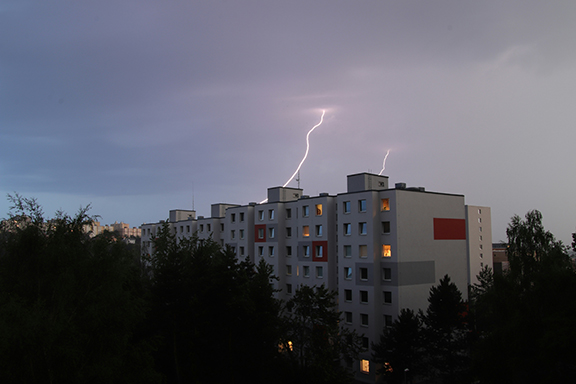
A deep-dive into the artificial intelligence architecture behind the world’s most advanced lightning risk assessment platform.
Lightning risk assessment has never been simple. For decades, engineers have relied on static historical maps, manual calculations, and outdated standards to determine how much risk a given structure faces from a lightning strike. It’s a time-intensive process prone to human error, inconsistent outputs, and compliance gaps. This is all happening while global standards like IEC 62305 continue to evolve, and as climate change rewrites historical lightning frequency data.
Skytree Scientific® was built to solve this exact problem. Its flagship SaaS platform, LRAplus®, rebuilds old processes from the ground up using a multi-layered complex algorithm, enhanced with AI technology, that handles everything from data intake to report generation. The result is a system that completes lightning risk assessments up to 90% faster, with greater accuracy, tighter compliance alignment, and dramatically reduced reporting costs.
So what’s actually happening under the hood? Here’s a full breakdown of the AI at work inside LRAplus®.
1. The AI Assistant: Real-Time Guidance at Every Step
The first layer of AI a user encounters in LRAplus® is the built-in AI Assistant: a conversational engine embedded directly within the platform workflow. This isn’t a bolted-on chatbot. It’s a context-aware guidance system that activates at each stage of the assessment process.
What it does:
- Provides instant, on-demand answers about compliance standards — specifically IEC 62305 (both the 2010 and 2024 editions), NFPA 780 (2023), and a growing range of regional standards that are coming to the market soon.
- Explains the why behind complex calculations as engineers work through them, reducing the need for external reference materials or specialists
- Offers real-time protection recommendations as the user builds out structures, zones, and risk profiles within a project
How it works:
The AI Assistant is built on a Large Language Model (LLM) foundation trained on lightning protection science, standards documentation, and engineering methodologies. It’s not simply retrieving pre-written answers; it’s synthesizing information from a curated, domain-specific knowledge base and applying it to the user’s specific project context. When an engineer asks “why does this structure have a higher Collection Area than expected?” or “which SPD class applies here under IEC 62305-4?”, the assistant responds with an explanation tailored to the active project variables.
This matters because lightning risk assessment calculations are notoriously complex. The interplay between structural dimensions, environmental factors, flash density data, connected line types, and zone classifications creates a decision tree that’s difficult to navigate under time pressure. The AI Assistant removes friction from that process without removing the engineer from the decision loop.
2. AI-Powered Recommendations: Closing the Loop on Protection Design
Once a structure is defined and risk values are calculated, LRAplus® shifts into recommendation mode. This is where its second major AI capability comes into play: the AI Recommendations engine.
What it does:
- Analyzes the full risk profile of a structure (including flash density data, structural characteristics, zone breakdowns, and environmental inputs) and generates specific lightning protection recommendations
- Identifies which areas carry the highest risk exposure and flags them for targeted intervention
- Suggests optimized protection measures (e.g., LPS level selection, SPD coordination, bonding strategies) based on both the calculated risk values and up-to-date data patterns
How it works:
The recommendations engine combines rule-based logic (derived from formal lightning protection standards) with pattern recognition trained on real-world lightning data and historical assessment outcomes. When a user reaches Step 3 of the LRAplus® workflow — creating and zoning structures — they can either apply protection measures manually or let the AI apply them automatically.
This is a significant capability. In traditional assessments, a protection engineer must mentally map risk values back to appropriate protection levels, often cross-referencing multiple standard documents simultaneously. LRAplus®’s AI does this synthesis in real time, offering a recommended configuration that can be adopted as-is or modified by the engineer.
3. Real-Time Data Integration: The Raw Material AI Needs
No AI is smarter than its data. LRAplus® addresses this with a data integration layer that connects directly to leading weather and lightning data providers.
What it ingests:
- Current flash density data: real-time and historical lightning flash rates per square kilometer per year for a given location
- Strike-point density metrics: more granular data on where lightning is actually terminating on the ground
- Integrated Strike Reports: optional full-strike data packages for a specific location, including map overlays, for clients who need deeper site-specific historical records
How it feeds the AI:
When an engineer pins a project location, the platform pulls live flash density values for that coordinate set. This eliminates one of the most common sources of error in traditional assessments, using outdated or regionally incorrect flash density values from static tables. The AI then uses this up-to-date data as a primary input in every subsequent calculation and recommendation.
Climate change is actively reshaping global lightning frequency patterns. A flash density value that was accurate in 2010 may be significantly underestimating current risk in many regions. By anchoring every assessment to live, validated data, LRAplus® ensures that its AI recommendations reflect the world as it actually is.
4. LLM-Powered Report Generation: Turning Calculations into Compliance Documents
One of the most time-consuming parts of any lightning risk assessment isn’t the math; it’s the documentation. LRAplus® collapses that process to minutes using LLM-powered automated report generation.
What it does:
- Pulls all project data (inputs, calculations, risk values, protection measures, structure details, zone breakdowns) and automatically drafts a complete, standards-compliant LRA report
- Generates reports in over 55 languages, making the platform usable for global engineering firms working across regulatory jurisdictions
- Outputs reports in editable .docx format, allowing engineers to apply branding, add narrative context, or incorporate client-specific information both before and after delivery
How it works:
The report generation engine uses a Large Language Model to translate structured project data into coherent, technically accurate prose. The LLM is responsible for writing the explanatory language that contextualizes calculations, describing why a given risk value was reached, which standard clause applies, and how the recommended protection measures address the identified risk. The output is consistent, professional, and audit-ready.
5. Where the AI Fits in the Engineering Workflow
The AI in LRAplus® does not replace the engineer. Every AI-generated recommendation, protection measure, and report output is available for human review, modification, and approval. The platform includes role-based access control and a peer reviewer function specifically to support internal sign-off workflows.
What the AI does is eliminate the parts of the assessment that don’t require engineering judgment — the data lookup, the standards cross-referencing, the report formatting — so that engineers can focus on the parts that do: interpreting edge cases, engaging clients, validating site conditions, and applying professional experience.
The practical outcome is a 90% reduction in time to complete an LRA, a significant reduction in reporting costs, and a much lower rate of compliance errors.
The Architecture in Summary
AI Layer | Function | Technology |
AI Assistant | Real-time standards guidance and calculation support | Domain-trained LLM |
Recommendations Engine | Automated protection measure selection and risk flagging | LLM + rule-based standards logic |
Data Integration | Up-to-date flash/strike density inputs to power calculations | API integrations with lightning data partners |
Report Generator | Automated compliant report drafting in 55+ languages | LLM with structured project data |
The Bottom Line
Skytree Scientific® isn’t selling AI as a feature; it supports the operational core of a platform that makes lightning risk assessment fundamentally better. The LRAplus® architecture reflects a clear understanding of where AI adds value in a technical workflow: handling volume and complexity so specialists can operate at the top of their license.
For engineering firms, insurers, government agencies, and lightning protection professionals dealing with more projects, tighter timelines, evolving standards, and shifting climate data, that’s not a marginal improvement. It’s a new baseline for how this work gets done.