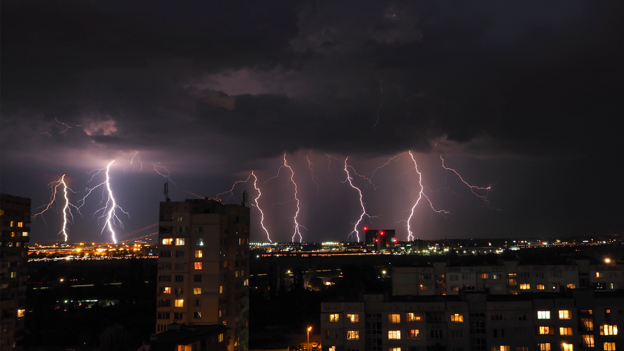
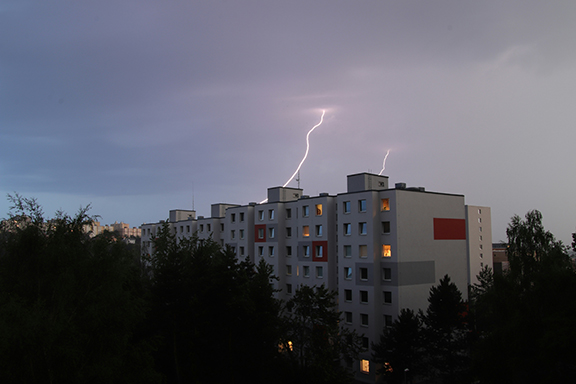
Lightning rods on the roof please auditors and insurance carriers. They signal that someone took protection seriously. But those air terminals only catch direct strikes. Surge paths through power and data cables remain exposed. These routes carry pulses straight into server rooms. A facility can pass a visual check and still lose gear to a surge on an unshielded fibre trunk or utility feed.
Data center lightning risk management starts with assessment. Most facilities install protection without measuring the gaps their current setup leaves open. Run the risk assessment before you spec another piece of hardware. That’s how you build documented budgets and close every gap.
Main Takeaways
- Lightning risk assessment under IEC 62305-2 sets the required protection level.
- Most data center damage comes from electromagnetic pulse and ground potential rise, not direct strikes.
- Full protection needs external and internal lightning protection tools.
- The 2024 IEC 62305-2 update swapped flash density for ground strike-point density. Risk parts were combined into R1 and R2.
- Facility growth, confirmed strikes, and standards updates trigger a fresh review of your protection programme.
Quantify Lightning Exposure Before Upgrades
See how data centers translate strike pathways and consequences into a quantified risk position. Read the deeper primer before you brief designers or insurers.
The Risk Assessment: What It Involves and Why It Comes Before Hardware

A lightning risk assessment is the structured process that tells you whether your facility needs protection. It also shows what grade and where to apply it. IEC 62305-2, the global standard for lightning risk, governs this calculation. The assessment isn’t the protection system itself. It’s the calculation that shapes what your protection system should look like and where your current setup falls short.
Air terminals on your roof capture direct strikes. That’s their job, and they do it well. But direct strikes aren’t what destroy most data center gear. Two indirect effects cause the bulk of damage:
- Electromagnetic pulse: This surge energy travels along power feeds, data cables, and telecom lines into your server rooms. It never touches the building shell.
- Ground potential rise: A strike injects current into the earth and creates voltage gaps between grounding systems that aren’t bonded. Gear linked across those isolated systems gets caught in the gap.
Your facility can have a full array of air terminals and still lose servers to a surge riding in on an unshielded fibre trunk. The 2024 update to IEC 62305-4 now sets design, inspection, and maintenance rules for surge protection measures that target these electromagnetic effects.
The IEC 62305-2 calculation begins with your building’s profile: length, width, height, and roof material. It factors in the ground strike-point density (Nsg) for your location. Nsg reflects how many strikes reach the ground per km2 each year. From there, the assessment maps every service line entering the facility, such as power, data, telecom. It then lists the internal systems exposed to damage: servers, cooling plants, fire suppression controls.
The output is two measured risk values. R1 covers the risk of injury to people inside the building. R2 covers the risk of lost service to the public. The standard sets a tolerable threshold for each. When your values exceed those thresholds, the assessment sets a specific Lightning Protection Level (LPL). It also pinpoints where surge protection devices (SPDs) must go. There’s no doubt in the result. You either meet the threshold or you don’t.
That finished document gives your protection designer a scope of work and your facilities director a budget backed by numbers. Your insurer gets a measured risk position. Without it, every hardware choice rests on guesswork.
Lightning risk assessment software like LRAplus® automates the IEC 62305-2:2024 calculation workflow, including the updated Nsg density inputs. What once took days of spreadsheet work now takes less than an hour.
Airport Lightning Rules: Who Sets Them and What's Mandatory

A complete data center lightning protection system (LPS) spans five distinct layers. Your risk assessment output sets which layers you need, at what specification, and where they go. Use the table below when scoping work with your protection designer.
Lightning Protection System Layers
| Protection Layer | Threat Addressed | Where Installed | Governing Standard |
|---|---|---|---|
| External LPS (air terminals, mesh conductors, down conductors) |
Direct strike capture and routing | Rooftop and façade | IEC 62305-1 |
| SPDs (Class I, II, III) |
Conducted surge on power and data lines | Service entry (Class I), distribution boards (Class II), equipment level (Class III) | IEC 61643 |
| Earthing & Equipotential Bonding | Ground potential rise and flashover | Foundation, structural steel, grounding network | EN 50522 / BS 7430 |
| Shielding | Radiated electromagnetic pulse | Cable trays and server rooms | IEC 62305-4 |
External LPS and Surge Protection
The external lightning protection system is the visible hardware layer. Air terminals are placed using the rolling sphere method. This technique rolls an imagined sphere of a set radius across the rooftop to find unshielded zones. Mesh conductors span the large flat roof areas common on data centers. Down conductors carry captured strike energy from the rooftop to the grounding system below. Together, these parts handle the direct strike.
SPDs pick up where the external LPS stops. They catch surges that travel along incoming power and data cables.
- Class I SPDs sit at the main service entry and absorb the highest-energy transient events.
- Class II devices at distribution boards catch whatever energy passes through.
- Class III devices protect single pieces of gear.
Grounding and Shielding
Earthing and equipotential bonding tie every conductive element in your facility to a single, low-impedance grounding network. Structural steel, cable trays, rack frames, and incoming services all connect to a common reference point. Without that bond, a lightning strike can create dangerous voltage differences between systems that have no direct electrical connection. In a data center, where hundreds of racks share power and communications infrastructure, even relatively small voltage differences can damage equipment across multiple rows.
Shielding helps protect against the electromagnetic effects of nearby lightning. Even when lightning never directly contacts a conductor, the resulting electromagnetic pulse (LEMP) can induce damaging voltages in nearby cables. Shielded cable trays, bonded metallic enclosures, and properly designed Lightning Protection Zones (LPZs) reduce the electromagnetic energy reaching sensitive electronics.
The Standard Behind Modern Lightning Protection
IEC 62305 is the internationally recognized standard for protecting structures and electronic systems from lightning. Used throughout Europe, the Middle East, Asia-Pacific, and many other regions, it provides a comprehensive framework covering risk assessment, external lightning protection systems, surge protection, and protection against lightning electromagnetic effects.
The 2024 edition of IEC 62305-2 introduced two significant updates. It replaced the legacy Ng (lightning flash density)with Nsg (ground strike-point density), providing more accurate lightning exposure calculations based on modern lightning detection data. It also simplified the risk model from four risk categories to two (R1 and R2), streamlining the assessment process while improving consistency. Organizations using assessments completed under the 2010 edition may find that today’s standard recommends different protection measures.
No single protection layer addresses every lightning threat. An external LPS captures direct strikes but cannot stop conducted surges entering through power or data lines. SPDs help limit those surges but rely on effective grounding to safely dissipate energy. Shielding reduces electromagnetic interference but does not replace surge protection or external lightning protection. A lightning risk assessment determines which protection layers are required, where they should be installed, and the level of protection needed for your specific facility.
Formal Infrastructure Risk Assessment Under IEC 62305-2:2024

Engineers perform a Formal Infrastructure Risk Assessment Under IEC using blueprints at a large-scale construction site.
A formal airport lightning safety assessment under IEC 62305-2:2024 does something your ramp closure SOP never will. It checks whether your infrastructure can survive a strike. Then it documents the protection level each structure requires.
Airports carry higher risk across two of the standard’s most important parts:
- R1 covers the risk of injury to people inside or near the structure.
- R2 covers the risk of loss of service to the public.
Terminals hold thousands of occupants. Control towers and navigation systems deliver continuous public services. Both factors push airports into the high-consequence category under IEC 62305-2.
The assessment itself examines structural exposure: building dimensions, site location, and surrounding terrain. Existing protection measures and strike consequences are also reviewed. Its output is a protection level determination. That determination shapes every later decision, from lightning protection systems to bonding.
BSI’s 2025 adoption of BS EN IEC 62305-4:2024 makes the stakes clear. The UK foreword warns it is “not safe” to implement protection measures without first completing a risk assessment.
Order a formal IEC 62305-2 assessment when:
- There’s new terminal or infrastructure construction
- There’s been a confirmed lightning strike on airport structures
- Insurers or licensing bodies request documented risk evidence
- Planning any infrastructure upgrade that changes structural dimensions or electrical systems
Your detection protocols handle day-to-day ramp decisions. The formal assessment is the engineering foundation that sits upstream of those protocols.
The Airport Lightning Risk Index
The Airport Lightning Risk Index measures how exposed a specific airport site is to lightning. It combines three inputs:
- Nsg (ground strike-point density), or the number of lightning strike points per km² per year at the site
- Traffic volume and occupancy patterns
- Structural traits of each assessed building
The 2024 edition of IEC 62305-2 replaced the older Ng (flash density) metric with Nsg. This matters because Nsg typically produces higher calculated strike frequencies. It can shift protection-level outcomes. Any assessment still built on Ng follows the replaced method.
The UK recorded more than 17,000 cloud-to-ground lightning flashes in 2024. September alone accounted for 6,043, according to Météorage. Airports in high-Nsg regions face a different risk profile than those in low-density areas.
Grounding Systems, Surge Protection, and Bonding
The formal assessment also checks the physical infrastructure behind safe lightning energy flow. Can a structure conduct and disperse that energy without damage?
Grounding system testing at airports uses insulation resistance measurement to verify low-resistance paths.
Testing covers:
- Constant current regulator (CCR) vaults
- Airfield ground lighting (AGL) circuits
- Switching gear
Surge protection devices (SPDs) are tested for coordination and adequacy. This applies to navigation aids, instrument landing systems, and CCR power feeds. Bonding requirements for fuel storage and distribution systems are tested against the standard. This is built on earthing of high-voltage power installations. Gaps in grounding or SPD performance affect protection level and risk.
A formal assessment is defence for every protection-level decision, based on engineering evidence. Insurers, regulators, and licensing bodies will accept it. The LRAplus® airport lightning safety assessment provides that evidence. And it does so in hours, not days.
Standardise IEC 62305-2 Assessments
Replace spreadsheet risk models with a repeatable workflow for Nsg, service-line mapping, and LPL selection. Evaluate whether LRAplus® fits your assessment process.
From Storm Response to Reassessment: Keeping Protection Current

A complete data center lightning risk management programme pairs the physical protection layers with active weather protocols. It has a maintenance cycle that catches wear before it becomes a gap.
A proactive protocol means you set storm approach thresholds. These trigger when lightning alerts detect activity within 10–15 km of your facility. Your team then matches those alerts with electrical system alarms in the NOC.
Once a storm clears, a post-event inspection should cover:
- SPD status markers on all three classes of devices
- Electrical system logs reviewed for transient events
- Grounding links verified at exposed points
This catches damage that doesn’t trip an alarm right away. A surge can weaken an SPD module or loosen a joint without causing a visible fault.
Between storms, protection systems wear down on their own. SPD parts degrade after absorbing repeated surges. Grounding links corrode. Down conductors loosen at joints exposed to weather. IEC 62305-4:2024 makes inspection, maintenance, and testing of surge protection measures a standard rule.
The programme isn’t done when the hardware goes in. It’s done when you have a cycle for proving it still works.
Three events trigger a full reassessment:
- New rooftops and service entries that change your collection area and create surge paths
- A confirmed strike event
- A standards update
London expects 187 MW of new data center capacity this year, per CBRE. Growth-driven reassessments are becoming routine across the industry.
Re-Run Your 2024 Reassessment Fast
When expansion or a standards update forces a reassessment, generate R1/R2 results and LPL targets quickly, so you can scope SPDs and bonding with confidence.
Try LRAplus Free for 14 DaysStart Your Data Center Lightning Risk Management Programme with Skytree Scientific®

Skytree Scientific® built LRAplus® to automate the IEC 62305-2:2024 assessment workflow. With it, you produce documented risk reports for insurers and protection designers in hours, not weeks. And you stop choosing hardware based on guesses about threats you haven’t measured.
See how Skytree Scientific® approaches lightning risk assessment for data centers and critical infrastructure. Try LRAplus free for 14 days and experience automated calculations and multilingual report generation.
FAQs about Data Center Lightning Risk Management
What happens if a lightning strike occurs between scheduled inspections?
Run an unplanned post-strike inspection right away. Cover these three areas:
-
- Check SPD status markers on all device classes
- Review electrical system logs for transient events
- Verify grounding links at exposed points
A strike can weaken SPD parts or loosen joints without triggering an alarm. IEC 62305-4:2024 makes inspection and testing of surge protection measures a standard rule, not optional.
Can I use lightning risk assessment software for multi-site facilities with different locations?
Yes, as long as the platform supports Nsg density inputs by location. Each site needs its own geographic Nsg value drawn from regional lightning location system data. Separate assessments must account for each site’s unique facility traits and service entry setup. Each site also requires its own collection area calculation. Multi-site teams benefit from central documentation and a steady method across all locations.
If my budget is limited, should I prioritise upgrading SPDs or grounding connections?
Let your assessment output guide the choice. If R1 or R2 values exceed tolerable thresholds mainly due to surges on incoming lines, fix SPD gaps first. When ground potential rise between isolated systems is the top risk, upgrade grounding and bonding instead. The IEC 62305-2 assessment measures which threat adds the most to your total risk, removing guesswork. Upgrading one layer while ignoring the main gap your assessment found leaves you exposed.