Standard lightning safety rules tell you what to do, but they don’t often tell you why those rules work. That gap leaves you guessing when the situation doesn’t match the rulebook.
Each rule exists because of a specific physical process that shapes your injury risk. Once you understand those processes, you’ll understand why each protocol works. That knowledge helps you act fast to keep yourself and others safe.
Main Takeaways:
- Ground current causes more lightning casualties than direct strikes. This is because it spreads outward through soil.
- Keeping your feet together during a storm reduces step voltage.
- 30% of lightning injuries happen indoors through plumbing, electrical wiring, and cable lines that conduct current into buildings.
- Seek cover when flash-to-bang is 30 seconds, and wait 30 minutes after the last thunder before going back outside.
- Lightning victims carry no residual charge and can be touched immediately to check for pulse and perform CPR.
Understand Lightning Safety In Operations
Explore the key standards that govern lightning protection and see how modern AI-guided tools are revolutionizing risk assessment.
Lightning Strike Mechanisms That Determine Your Risk

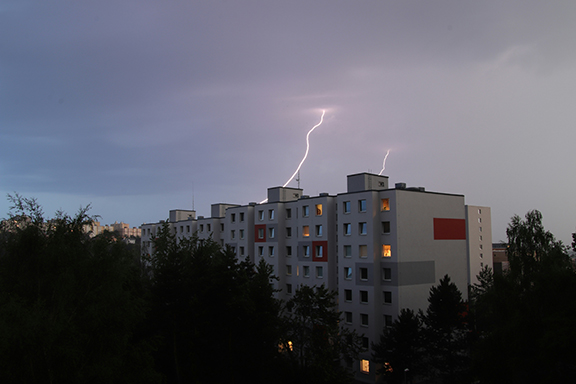
A lightning strike is a cloud-to-ground discharge carrying up to 300 million volts. There are five different “strike types,” per NOAA.
Direct Strike
The lightning channel contacts your body with no go-between. This is the rarest of the five types, but it carries the highest fatality rate. Stay out of open areas where you’d be the tallest object.
Side Flash
Lightning hits a taller nearby object, like a tree, utility pole, or flagpole, and part of the current arcs sideways to you. This jump can cross a gap of 15 feet. That’s why you should never shelter under a lone tree.
Ground Current
After lightning hits the earth or any grounded object, current radiates outward through the soil. The voltage difference between your two feet (called step voltage) forces current up one leg and down the other. Because this affects the widest area around any strike point, it causes most lightning casualties.
Wider foot spacing means a greater voltage difference and more current through your body. Lying flat is one of the worst things you can do, because it maximizes soil contact and exposes your torso to the full spread of current. To lower risk, keep your feet together. If you’re in a group, spread out by 50–100 feet so one event doesn’t take everyone down.
Ground current also produces surface arcs. These horizontal bursts of current radiate from the strike point at ground level, and can travel over 65 feet. They appear faster than you can react. Distance from the strike point is your primary protection.
Conduction
Lightning current travels through metal and water systems, such as plumbing pipes, electrical wiring, chain-link fencing, and railroad tracks. Anyone touching those conductors during a surge receives the shock.
During a storm, avoid contact with metal or anything tied to your building’s plumbing. For outdoor crews, this extends to wet ropes, hoses, or cables near a strike point, as well.
The danger from large metal objects is conduction, not attraction. Small personal metal items like jewelry, belt buckles, or tools in a pocket don’t meaningfully increase your chances of being struck. Height, isolation, and exposure to open terrain are what drive attachment probability.
Streamers
As a lightning channel drops from the cloud, upward discharges rise from the ground to meet it. Even when the main bolt connects to a different streamer, the unconnected ones can still deliver a powerful shock. If your hair rises or your skin tingles, a streamer is forming from your body. You’re seconds from a strike. Crouch right away.
Current fans out through the ground from every strike point. That’s why every outdoor safety rule focuses on minimizing ground contact and exposure. Make yourself small, keep your feet together, and put distance between yourself and others.
Lightning Safety Indoors

Roughly 30% of lightning injuries happen inside a building, according to the CDC. A structure shields you from direct strikes, side flashes, ground current, and streamers. But conduction can follow you through walls. Lightning enters buildings through three paths, and each can deliver current straight to your body.
- Plumbing: Lightning current travels through metal water pipes. If you’re showering, bathing, or washing dishes when current enters the system, water creates a direct path to you.
- Electrical wiring: A strike to a power line or the building itself sends current through the electrical system. Anything plugged into an outlet becomes a conductor.
- Cable and antenna lines: TV coaxial cable, hardwired internet, and antenna feeds all carry current from an outside strike to indoor equipment.
Knowing those three paths turns a long list of indoor rules into a short set of principles:
- Stay away from water. No showers, baths, or dishwashing. Plumbing connects you to the building’s exterior.
- Don’t use corded phones. The phone line is a direct conduction path. Cordless and cell phones are fine.
- Avoid plugged-in electronics. Computers, gaming consoles, and corded appliances can carry current from a grid strike.
- Keep clear of windows and doors. Metal frames conduct current, and shock waves from a close strike can shatter glass.
- Stay off concrete floors and away from concrete walls. Rebar inside the concrete can carry current.
- Bring pets inside. Keep them away from metal dog doors and water bowls near plumbing fixtures.
For facilities where lightning risk needs formal review, a standards-based lightning risk assessment shows whether protection is required and at what level.
Can Lightning Strike Through a Window?
Lightning doesn’t pass through intact glass. However, metal frames can conduct current into the room, and the shock wave from a close hit can blow glass inward. In older homes, lightning can find a path through gaps or cracks around the frame.
You don’t need to board up windows during a storm. Just don’t stand near them or lean against metal frames.
If lightning strikes your house, check for fire right away. Inspect the attic and interior walls first, because a strike can ignite insulation or wiring in hidden spaces. Don’t touch the electrical panel. Call 911.
Turn Storm Decisions Into Defensible Numbers
If you manage outdoor teams and facilities, you need a documented risk assessment that lays out lightning safety protocols. Evaluate how we structure IEC 62305-2 inputs and outputs across sites.
Lightning Safety Outdoors

How can you stay safe during a thunderstorm when you’re already outside? Recognize the threat and reach the best shelter you can. If shelter is impossible, reduce your exposure.
Recognize the Threat
The 30-30 rule is the most reliable trigger for lightning storm safety. If the gap between a flash and thunder is 30 seconds or less, seek shelter right away. A 30-second flash-to-bang interval puts lightning within six miles, according to NOAA.
Six miles sounds safe, but lightning can hit the ground more than 10 miles from the storm center, per the NWS. Storm cells can stall, split, or reverse without warning, so don’t go back outside until 30 minutes after the last thunderclap.
For large worksites and events, the NWS recommends an 8-mile threshold (40-second flash-to-bang count). That extra margin gives bigger groups enough time to find shelter.
Reach the Best Shelter You Can
Where you shelter matters as much as when. Not every structure offers the same protection.
A large, enclosed building such as a school, home, or office, is the safest option. The wiring and plumbing form a grounding network that routes current around you. Avoid conduction pathways inside.
The next safest option is an enclosed, metal-topped vehicle. Convertibles and open-bed trucks offer no protection. Roll windows up completely. The metal shell channels current around the exterior. Don’t touch metal interior parts.
Reduce Your Exposure
If shelter isn’t available, reduce your exposure to each strike type by doing the following:
- Spread out from your group by 50–100 feet.
- Crouch low on the balls of your feet, feet together, head tucked, hands over your ears.
- Never lie flat on the ground.
- Stay away from isolated trees, hilltops, open fields, and water.
- In a forest, seek shorter, denser tree cover. A canopy overhead is better than a single tall trunk beside you.
- Get off ridges and peaks. Elevated terrain puts you closer to the descending channel and raises your exposure to streamers.
Identify shelter locations before you start any activity or outdoor event. Designate someone to monitor storm conditions. Then make sure everyone knows the shelter trigger and rally point.
What to Do If Someone Is Struck by Lightning
Almost 90% of people struck by lightning survive, according to the CDC. But many face chronic pain, memory loss, personality changes, and depression. Neurological disorders can persist for years.
If someone is struck, you can touch them right away. Lightning strike victims don’t carry a residual electrical charge. That’s the single most important thing to know, because hesitation costs lives.
Call 911 first. Then check for cardiac arrest. If the person is unresponsive and not breathing normally, start chest compressions right away.
After that, check for secondary injuries. Most strike victims experience a flashover, where the current travels over the skin’s surface rather than through the body. This produces linear burns, spotted burns, or fern-like skin patterns instead of deep wounds. Also check for blunt trauma from the explosive force and ruptured eardrums.
Don’t move the victim unless a second strike poses an immediate threat. Keep monitoring for delayed cardiac events until EMS arrives.
Validate Your Site’s Lightning Exposure Fast
Use your facility details to produce a standards-based lightning risk assessment you can share with safety, engineering, and leadership.
Protect Your People and Infrastructure with Skytree Scientific®

When lightning safety scales from personal choices to facility-level protection, the same physics-first thinking applies. But the stakes are higher and decisions need formal records. Organizations can measure their exposure through standards-based methods that show whether protection is needed, at what level, and where to invest first. Skytree Scientific® was built for exactly that work.
Try LRAplus free for 14 days and see how standards-compliant risk assessments can get you the precise data you need, in just hours.