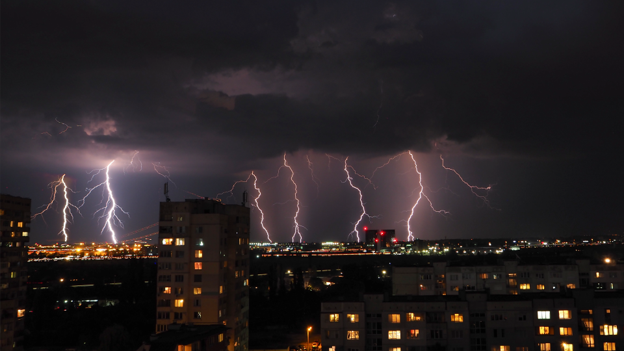
This week the Lightning Protection Institute (LPI) is running its first Risk Assessment Week, built around a single question: “What’s at RISK?” One of its central points is that a lightning risk assessment belongs at the design stage and should be revisited throughout a structure’s life. LPI names the moments that call for it: “A renovation, a new roof, a change in use, or a storm or strike can all change the risk.” (LPI, Oct 15, 2026)
The IEC 62305 series shows why that advice holds. A risk assessment is a calculation built from facts about one building: its size and surroundings, how it is built, what it is used for, who is inside and which lines feed it. When those facts change, the result can change too. An assessment that was right on the day it was done can stop describing the building it was done for, without anyone noticing.
What the result depends on
IEC 62305-2:2024 expresses each risk component with one general equation:
RX = NX × PX × LX
Each term is tied to something specific about the structure:
- NX, the number of dangerous events per year, depends on the lightning ground strike-point density (NSG) and on the physical characteristics of the structure, its surroundings, its connected lines and the soil.
- PX, the probability of damage, depends on the characteristics of the structure, the connected lines, the attendance of persons and the protection measures provided.
- LX, the extent of loss, depends on the use to which the structure is assigned.
The total risk R is then compared with the tolerable risk RT. If R is higher, protection is needed: measures are selected and the risk is recalculated until R is at or below RT.
In other words, the result is only as current as the inputs behind it.
Changes that can move the result
Most of the events LPI lists map directly onto those inputs.
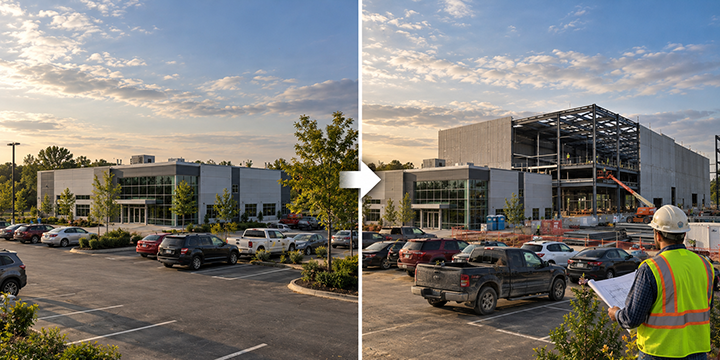
| Change to the building | What it affects in the calculation |
|---|---|
| Extension, added storeys, new roof structures or rooftop plant | Dimensions and collection area, which drive the number of dangerous events; construction characteristics |
| Change of use or occupancy | Loss, which follows the use of the structure; presence of people; fire-related factors |
| New or rerouted power or telecom lines | Dangerous events on connected lines, and the shielding and protection of those lines |
| New sensitive equipment or internal systems | Impulse withstand voltage of equipment; the need for coordinated surge protection |
| Protection measures added, removed or degraded | Probability of damage |
| New or demolished buildings nearby | Location factor, which accounts for surrounding objects |
Some of these changes push risk up and some push it down. A new tower next door can lower the location factor, while converting a warehouse into offices or a data hall changes the use, occupancy and contents that the loss values were based on. Either way, the old number no longer reflects the building.
A strike or an alteration is also a reason to inspect
IEC 62305-3:2024, which covers the protection system itself, points to the same events. It says inspections should be made after alterations or repairs, and when it is known that the structure has been struck by lightning. One stated objective of inspection is to confirm that added or modified services, equipment or constructions, and changes to the building, its equipment or its purpose, are addressed in the lightning protection system (LPS) design. Where a structure or its installations are modified, the standard says to check whether the existing protection still conforms and, if it is inadequate, to improve it without delay.
Those are inspection provisions for the LPS. They are also a sensible prompt to ask whether the inputs to the risk assessment still hold, because an LPS is designed to answer the risk the assessment found.
The standard has changed, too
An assessment carried out under IEC 62305-2:2010 is built on a different basis from one carried out under the 2024 edition. The 2010 edition calculates dangerous events from the ground flash density, NG. The 2024 edition replaces it with the ground strike-point density, NSG, and says the number of dangerous events shall be obtained mainly from lightning location system (LLS) data, with the LLS complying with IEC 62858. The 2024 edition also introduces a single risk that combines loss of human life and loss due to fire, and a frequency of damage for internal systems.
A 2010-edition assessment is not wrong for the edition it used, but its results are not directly comparable with a 2024-edition result. If a project, client or authority now specifies the 2024 edition, an older assessment will usually need to be run again.
Keep the inputs on record
LPI makes the point that “a documented lightning risk assessment is a first step in mitigating that risk early, limiting loss and supporting insurability.” Documentation also makes the next update much easier. Whoever revisits the assessment should be able to see:
- which edition of IEC 62305-2 was used
- the source and date of the lightning data
- the dimensions, surroundings and lines that were assumed
- the use, occupancy and loss values that were entered
- the protection measures that were credited
With that record, an update becomes a review of what changed rather than a fresh start.
A practical rule
Treat the risk assessment as part of the building record, not a design-stage deliverable that gets filed. Look at it again whenever the building, its use, its lines or its protection change, after a known strike, and when the edition you are working to changes. If nothing material has changed, a short review confirms the assessment still stands. If something has, run it again.
LRAplus®, Skytree’s lightning risk assessment software, is built for this kind of work. If you have existing assessments to update this Risk Assessment Week, learn more about LRAplus.