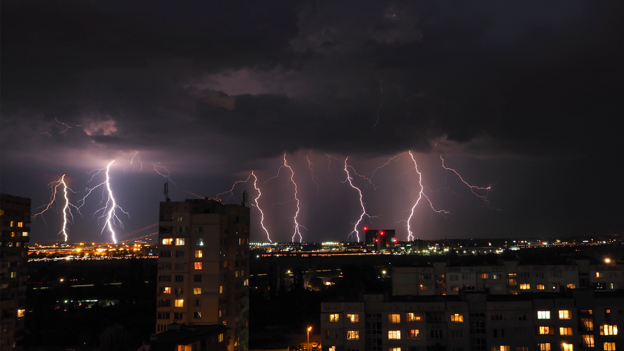
Your airport has a lightning detection system. When a strike registers within 8 km, ramp operations stop. The all-clear sounds and work resumes 15 minutes after the last strike. That protocol protects your ground crews during the storm. However, it doesn’t tell you whether your structures can survive the strike.
Most airports have ramp protocols but no formal infrastructure risk assessment. The first is a real-time safety trigger. The second is engineering work. A lightning risk analysis determines if your buildings can withstand a direct strike. It assigns each a protection level.
This article will show you how to document infrastructure risk beyond ramp protocols. You’ll also build the compliance record that licensing bodies and insurers now expect.
Main Takeaways
- Ramp protocols protect ground crews during storms. They don’t assess whether airport infrastructure can survive a direct strike.
- IEC 62305-2:2024 is the standard that guides compliance for insurance companies.
- The IEC 62305 2024 update reduced risk parts and changed the lightning density metric from Ng to Nsg. This affects all prior work.
- The 2024 standard replaced Ng (flash density) with Nsg (ground strike-point density). Nsg typically produces higher calculated strike frequencies.
- Airports carry higher risk because high occupancy raises risk R (injury to people and physical damage), and critical systems make the frequency of damage F especially important.
Map What a Lightning Risk Assessment Covers
See how strike probability, consequences, and protection requirements are quantified across critical facilities. Use it to benchmark what your airport assessment should document. Read the Lightning Risk Assessment GuideOperational Protocols and the Standards That Govern Them

Operational lightning safety protocols dictate when to pause and restart ramp activity. They keep ground crews out of harm’s way during active storms. But they don’t check whether your buildings, electrical systems, or airfield lighting can absorb a direct strike.
Once a lightning detection system picks up a strike within 8 km, most airports halt ramp operations. That’s the lightning delay airport teams worldwide rely on. Under the modified 30/30 rule, high-precision detection shortens the timeline.
IATA’s two-tier alert framework adds more structure: an 8-km warning radius and a 4.8-km danger radius. Detection networks are getting sharper, too. The Met Office launched the LEELA network in 2025, which delivers twice the detection power.
But these are operational decisions. They govern when you stop and start work on the ramp. The lightning strike that triggered the closure can still take out your:
- Terminal roof
- Control tower electronics
- Runway lighting
Airport Lightning Rules: Who Sets Them and What's Mandatory

Several groups publish airport lightning rules. They vary widely in scope, whether compliance is required, and what records you must have. No single body prescribes a universal radius or wait time.
FAA lighting rules under AC 150/5210-24 are advisory best practices for ground safety. They’re not mandatory.
EASA requires airports to have documented adverse-weather procedures and electrical system maintenance programmes. Specific distance thresholds and wait times are left to each airport’s local SOPs.
Airport Lightning Rules by Governing Body
| Body | Scope | Status | Documentation Requiered |
|---|---|---|---|
| FAA (AC 150/5210-24) | Operational best practices for ground safety | Advisory | Recommended SOPs |
| ICAO (Annex 14) | International aerodrome standards | International standard (adopted by member states) | Safety management system |
| IATA (AHM 632) | Ground handling operational guidance | Industry guidance | Operational procedures |
| IEC 62305-2:2024 | Infrastructure risk assessment and protection level determination | Engineering standard (mandatory where adopted) | Formal risk assessment report |
| NFPA 780 (Annex L) | US infrastructure risk assessment | Standard of care (US market) | Risk assessment documentation |
FAA, ICAO, and IATA address operational decisions: when to halt work and when to resume. IEC 62305-2 and NFPA 780 address infrastructure: whether your structures can survive a strike. Insurers, regulators, and licensing bodies now expect proof you’ve assessed and mitigated risk.
Three standards govern lightning protection studies worldwide:
- NFPA 780-2023 Annex L applies to US facilities.
- IEC 62305-2 is the global standard used across Europe, the Middle East, Asia, and most other markets.
- BS EN 62305 is the UK’s national adoption of IEC 62305.
BSI recently published an updated 2024 framework (BS EN IEC 62305-2:2024), making it the current UK benchmark. It sets what your lightning protection study must produce:
- Calculation method
- Required inputs
- Compliance records
Lightning protection testing requirements, the periodic inspections of installed systems, are covered in parts 3 and 4 of these standards.
What Changed in IEC 62305-2:2024 Edition 3
Edition 3 brought three changes that affect every existing assessment:
- The risk and loss framework was restructured. The previous R1–R4 framework was replaced by a single risk R, covering injury to human beings and physical damage to the structure and its contents. Where failure of internal systems applies, a separate frequency of damage F is calculated.
- The lightning density metric changed from Ng to Nsg. Nsg is ground strike-point density. It measures actual impact points per km2 per year. It’s a more precise input than the older flash density metric (Ng). Any tool or spreadsheet still using Ng follows the old method.
- Thunderstorm warning systems were added to the risk framework. Systems that meet IEC 62793 are now treated as a protection measure within the calculation itself.
If your facility’s study was done under IEC 62305-2:2010, its risk values may not match the current standard’s inputs and thresholds. Reviewing them against the 2024 framework is worth the effort. LRAplus supports both the 2010 and 2024 editions of IEC 62305-2. Teams can run assessments under either version and compare results directly.
Formal Infrastructure Risk Assessment Under IEC 62305-2:2024

Engineers perform a Formal Infrastructure Risk Assessment Under IEC using blueprints at a large-scale construction site.
A formal airport lightning safety assessment under IEC 62305-2:2024 does something your ramp closure SOP never will. It checks whether your infrastructure can survive a strike. Then it documents the protection level each structure requires.
Airports carry higher risk on both of the standard’s key measures:
-
- Risk R covers injury to people inside or near the structure and physical damage to the structure and its contents.
- Frequency of damage F covers failure of internal systems, such as navigation, lighting and communications. IEC 62305-2:2024 addresses loss of service to the public through F.
Terminals hold thousands of occupants. Control towers and navigation systems deliver continuous public services. Both factors push airports into the high-consequence category under IEC 62305-2.
The assessment itself examines structural exposure: building dimensions, site location, and surrounding terrain. Existing protection measures and strike consequences are also reviewed. Its output is a protection level determination. That determination shapes every later decision, from lightning protection systems to bonding.
BSI’s 2025 adoption of BS EN IEC 62305-4:2024 makes the stakes clear. The UK foreword warns it is “not safe” to implement protection measures without first completing a risk assessment.
Order a formal IEC 62305-2 assessment when:
-
- There’s new terminal or infrastructure construction
- There’s been a confirmed lightning strike on airport structures
- Insurers or licensing bodies request documented risk evidence
- Planning any infrastructure upgrade that changes structural dimensions or electrical systems
Your detection protocols handle day-to-day ramp decisions. The formal assessment is the engineering foundation that sits upstream of those protocols.
The Airport Lightning Risk Index
The Airport Lightning Risk Index measures how exposed a specific airport site is to lightning. It combines three inputs:
-
- Nsg (ground strike-point density), or the number of lightning strike points per km² per year at the site
- Traffic volume and occupancy patterns
- Structural traits of each assessed building
The 2024 edition of IEC 62305-2 replaced the older Ng (flash density) metric with Nsg. This matters because Nsg typically produces higher calculated strike frequencies. It can shift protection-level outcomes. Any assessment still built on Ng follows the replaced method.
The UK recorded more than 17,000 cloud-to-ground lightning flashes in 2024. September alone accounted for 6,043, according to Météorage. Airports in high-Nsg regions face a different risk profile than those in low-density areas.
Grounding Systems, Surge Protection, and Bonding
The formal assessment also checks the physical infrastructure behind safe lightning energy flow. Can a structure conduct and disperse that energy without damage?
Grounding system testing at airports uses insulation resistance measurement to verify low-resistance paths. Testing covers:
-
- Constant current regulator (CCR) vaults
- Airfield ground lighting (AGL) circuits
- Switching gear
Surge protection devices (SPDs) are tested for coordination and adequacy. This applies to navigation aids, instrument landing systems, and CCR power feeds. Bonding requirements for fuel storage and distribution systems are tested against the standard. This is built on earthing of high-voltage power installations. Gaps in grounding or SPD performance affect protection level and risk.
A formal assessment is defence for every protection-level decision, based on engineering evidence. Insurers, regulators, and licensing bodies will accept it. The LRAplus™ airport lightning safety assessment provides that evidence. And it does so in hours, not days.
Streamline IEC 62305-2 Airport Assessments
If you’re juggling Nsg data, multi-structure inputs, and report assembly, evaluate a single workflow built for IEC 62305-2, with NFPA 780 Annex L coming soon.
Post-Strike Infrastructure Assessment Checklist

A safety officer checks equipment against a Post-Strike Infrastructure Assessment Checklist to ensure continued operational integrity.
The following checklist covers what your team should do after a lightning strike on airport infrastructure. Keep it as a structured reference for post-strike response.
-
- Inspect AGL circuits for lamp failures, cable damage, and CCR faults.
- Test navigation aids (ILS, PAPI, VASI) for signal integrity and calibration drift.
- Verify SPDs on all critical circuits. Replace any that show fault indicators or test as failed.
- Conduct grounding continuity testing at the strike zone and adjacent structures.
- Inspect bonding connections at fuel storage and distribution points.
- Document all findings for insurance claims and regulatory compliance records. Include photographs, test readings, and timestamps.
- Keep the post-strike report alongside your existing risk assessment documentation.
This is where operational safety and formal risk assessment converge. A complete post-strike record protects you during:
-
- Insurance claims
- Regulatory audits
- Future assessment updates
Run Your First Airport Assessment
Document terminal, control tower, and AGL infrastructure risk under IEC 62305-2:2024. Generate protection-level outputs and compliance reports.
Try LRAplus Free for 14 DaysMake Your Airport Infrastructure Risk Assessment Defensible with Skytree Scientific®
Skytree Scientific® automates the required IEC 62305-2:2024 calculations and Nsg data integration. You get defensible documentation for insurance compliance and regulatory review. Best of all, there’s no manual spreadsheet work. Protection-level determinations are backed by site-specific lightning data and standards-compliant methodology.
See how Skytree Scientific® supports formal lightning risk assessments for airports. Start your free standards-compliant airport risk assessment.
FAQs about Airport Lightning Safety Assessments
When should an airport do a formal IEC 62305-2 assessment?
Order a formal assessment for:
-
- New terminal or infrastructure construction
- After a confirmed lightning strike on airport structures
- Future assessment updates
- When requested by insurers or licensing bodies
- Any infrastructure upgrade that changes structural dimensions or electrical systems
UK airports should note CAP 168 Edition 13 for licensing compliance.
How do I verify that my airport’s grounding system meets current standards after a lightning strike?
Conduct grounding continuity testing using the meggometer method at the strike zone and nearby structures. Verify low-resistance earth paths at CCR vaults and AGL circuits. Document all test readings with timestamps. Test against BS EN 50522:2022+A1:2024 requirements for HV earthing systems. Findings feed into post-strike compliance records. They also inform whether your protection-level determination needs updating.
What if my airport’s risk assessment still uses the old Ng metric instead of Nsg?
Assessments using Ng (flash density) instead of Nsg (strike-point density) follow the replaced IEC 62305-2:2010 method. They will typically understate calculated strike frequency. That can lead to incorrect protection-level determinations. Nsg typically yields higher strike frequencies, which changes the calculated risk R and frequency of damage F. Reassessment under the 2024 standard is required to align with current UK/EU regulatory expectations.
Can I implement lightning protection upgrades for airfield lighting or navigation aids without completing a formal risk assessment first?
No, BSI’s 2025 adoption of BS EN IEC 62305-4:2024 warns it’s “not safe” to implement protection measures without first completing a risk assessment. Partial work creates compliance exposure. Protection-level decisions (LPL I–IV) must follow the formal risk calculation. This applies to surge protection devices, bonding, and LPS design for CCR vaults, AGL circuits, and ILS/PAPI systems.